
Flyers Printing in Dubai
Introduction
Flyers remain one of the most practical printed marketing materials for promoting products, services, offers, events, and local businesses. With the right design and printing specifications, a flyer can deliver a clear message, strengthen brand visibility, and encourage customers to take action.
However, choosing the right flyer is not simply about printing a design on paper. The size, shape, paper type, GSM, finishing, printing method, and layout all influence the final result.
For example, an A5 flyer can be a practical choice for direct distribution, while a DL flyer can work well for compact promotional messages. A custom die-cut flyer may be more appropriate when visual differentiation is an important part of the campaign.
This guide explains the most common flyer sizes, shapes, paper types, finishing options, printing methods, and preparation requirements, helping businesses choose the right flyer for their marketing goals.
What Are Flyers and Why Are They Important for Marketing?
A flyer is a printed promotional material designed to communicate a marketing message in a compact and easily distributable format.
Businesses use flyers to promote:
Special offers
New products
Services
Store openings
Events
Seasonal campaigns
Restaurant promotions
Real estate properties
Healthcare services
Retail promotions
A successful flyer should communicate three things quickly:
What is being offered? Why should the customer care? What should the customer do next?
That is why good flyer printing requires more than attractive visuals. The design, message, size, paper, and finishing should work together to support the campaign objective.
Different Flyer Sizes
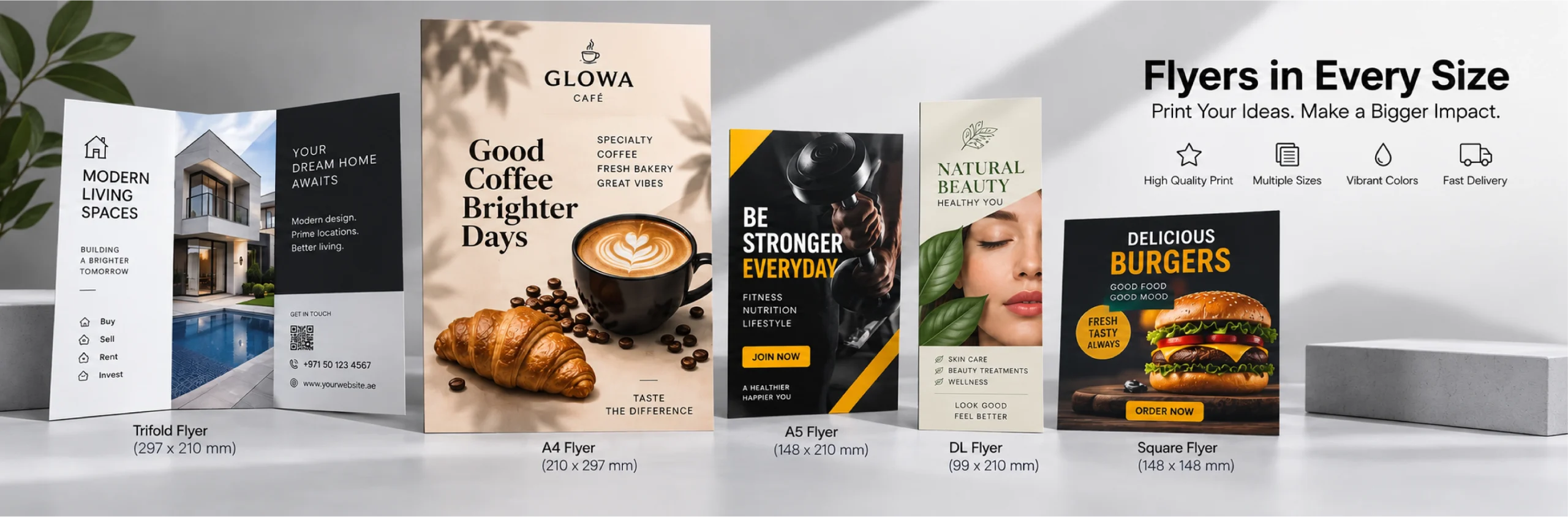
Choosing the right flyer size is one of the first decisions to make before preparing artwork for printing.
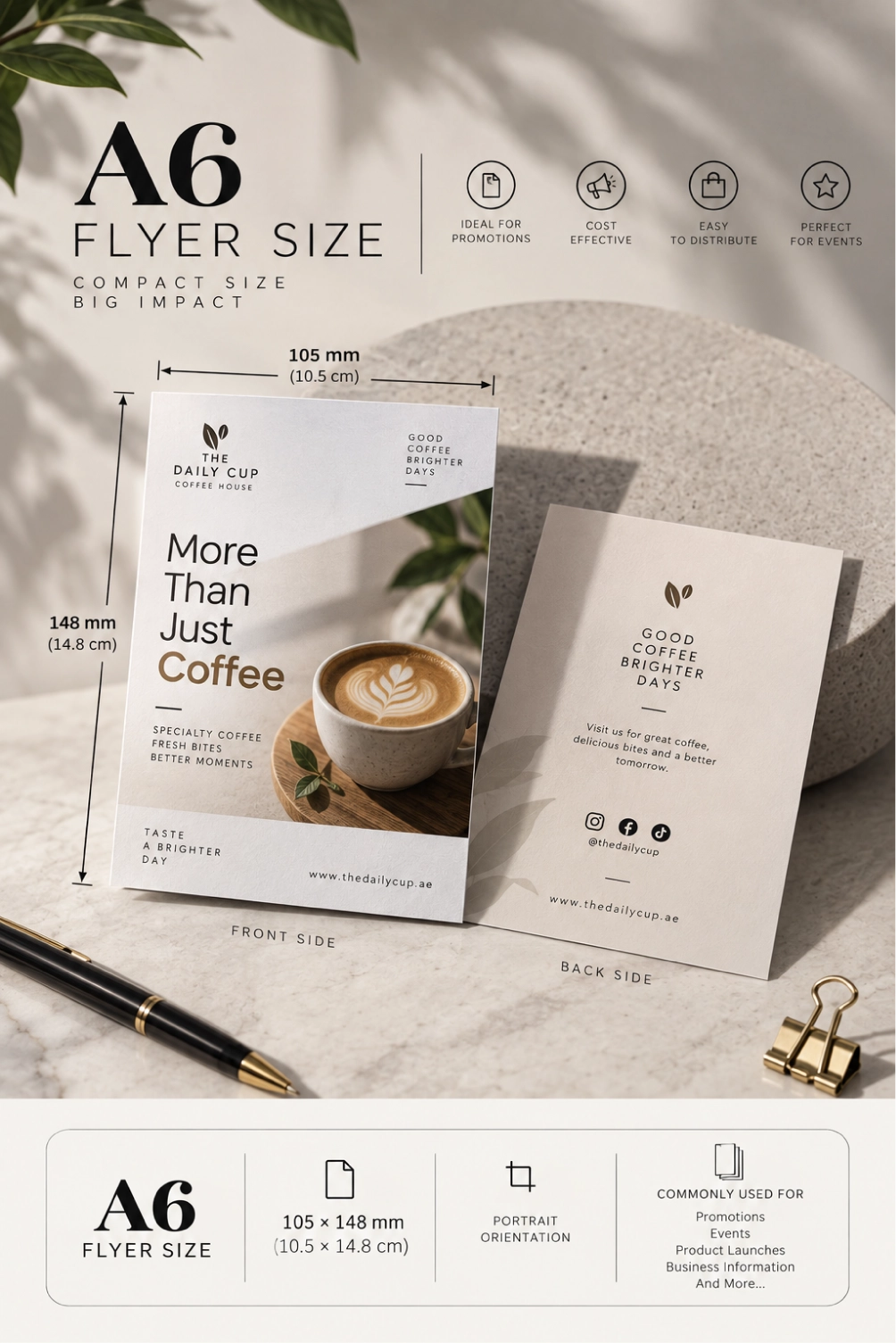
A6 Flyers
A6 dimensions: 105 × 148 mm
A6 is a compact format that works well when the message needs to remain short and easy to distribute.
Typical uses include:
- Coupons
- Promotional offers
- Small event handouts
- Restaurant promotions
- Retail discounts
- Promotional inserts
The main advantage of A6 is portability. The limitation is its smaller design area, which means content needs to remain highly focused.
A5 Flyers
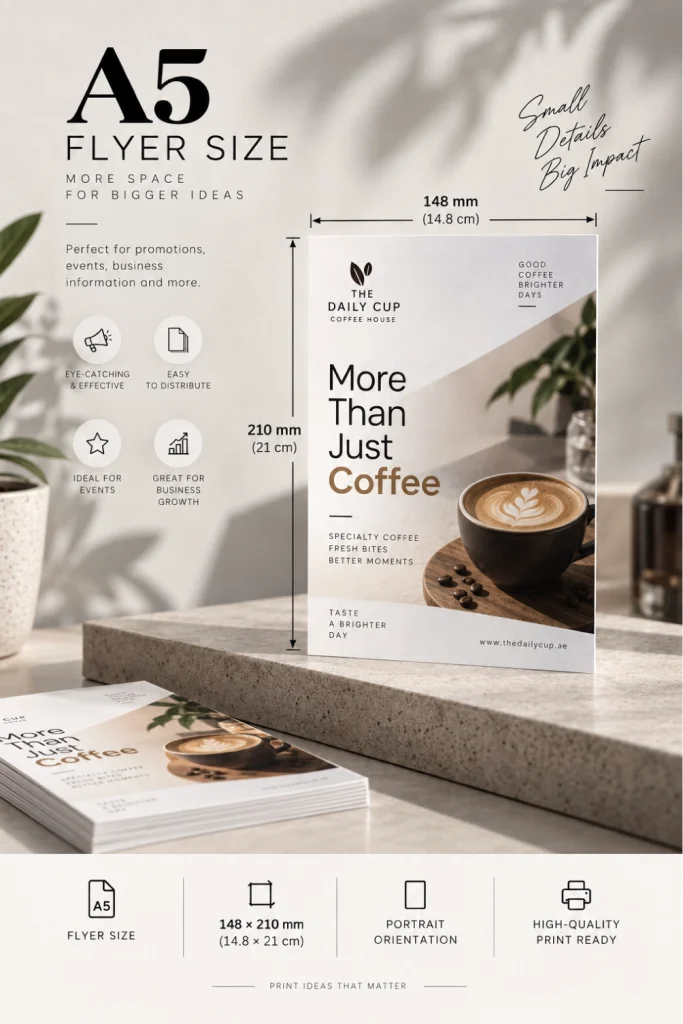
A5 dimensions: 148 × 210 mm
A5 is one of the most practical flyer formats because it provides a useful balance between portability and design space.
A5 flyers can work particularly well for:
- Restaurants
- Cafes
- Retail stores
- Beauty salons
- Clinics
- Real estate promotions
- Events
- Local marketing campaigns
A5 is often a strong choice when the design needs space for an image, headline, offer, supporting information, and a clear call to action without becoming unnecessarily large.
A4 Flyers
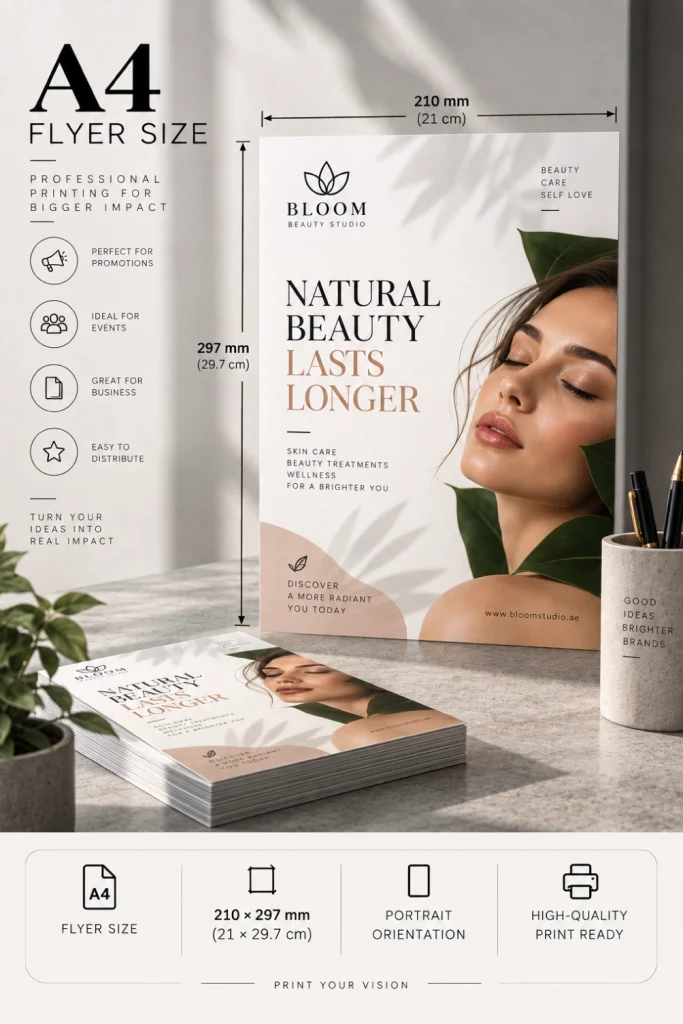
A4 dimensions: 210 × 297 mm
A4 provides considerably more design space and is useful when the flyer needs to communicate more information or display multiple products or services.
Common applications include:
- Detailed promotions
- Service information
- Product promotions
- Corporate communication
- Multiple-offer campaigns
The additional space should not be treated as a reason to add more text. Good A4 flyer design still depends on clear visual hierarchy and effective use of whitespace.
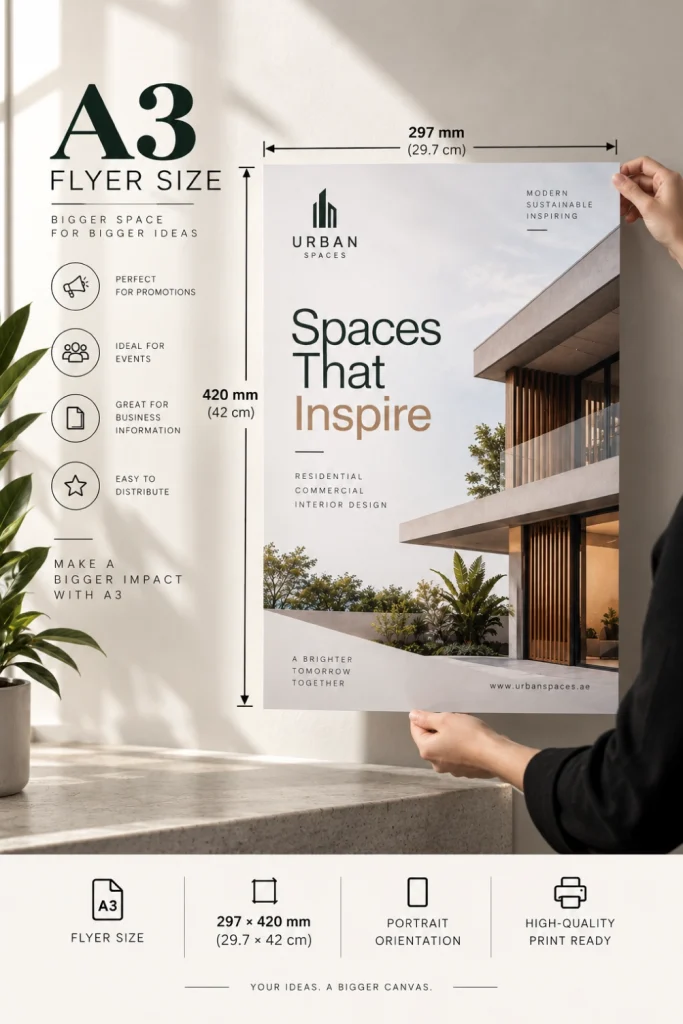
A3 Flyers
A3 dimensions: 297 × 420 mm
A3 offers significantly more visual space than A4 and can be useful when larger printed communication is required.
It can be considered for:
- Larger promotional displays
- Event materials
- Retail campaigns
- Visual-heavy promotions
The value of A3 depends on the way the flyer will be displayed or distributed. A larger size is not automatically a better marketing solution.
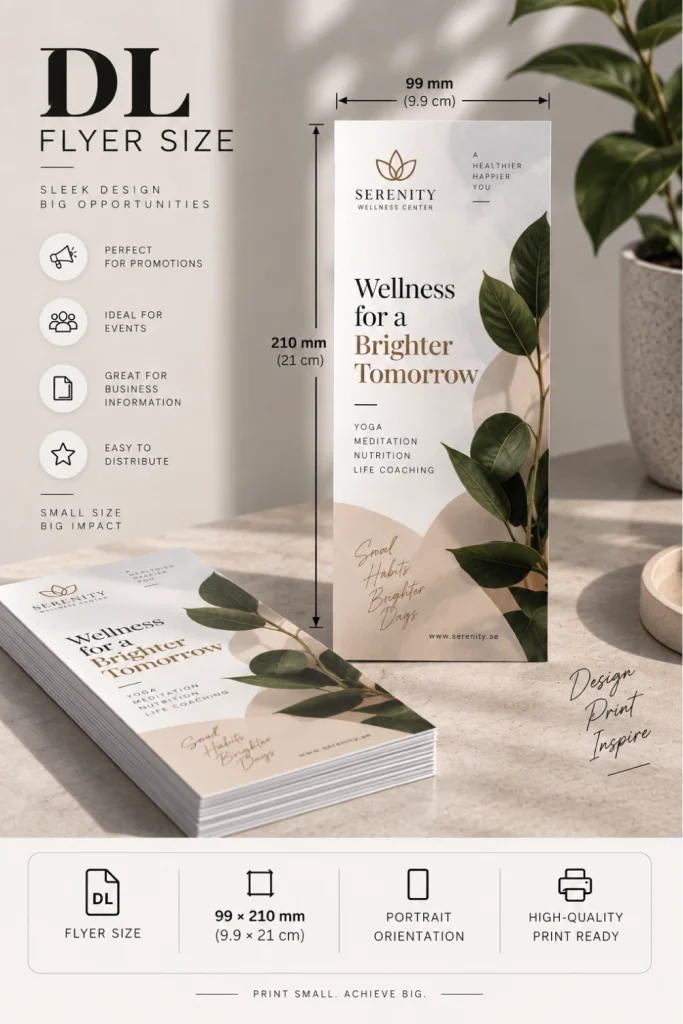
DL Flyers
Common DL dimensions: 99 × 210 mm
DL is a narrow, vertical format commonly used for concise promotional communication.
Typical uses include:
- Menus
- Coupons
- Event information
- Promotional inserts
- Service lists
- Real estate information
Its narrow format makes it visually distinctive while remaining practical for many distribution situations.
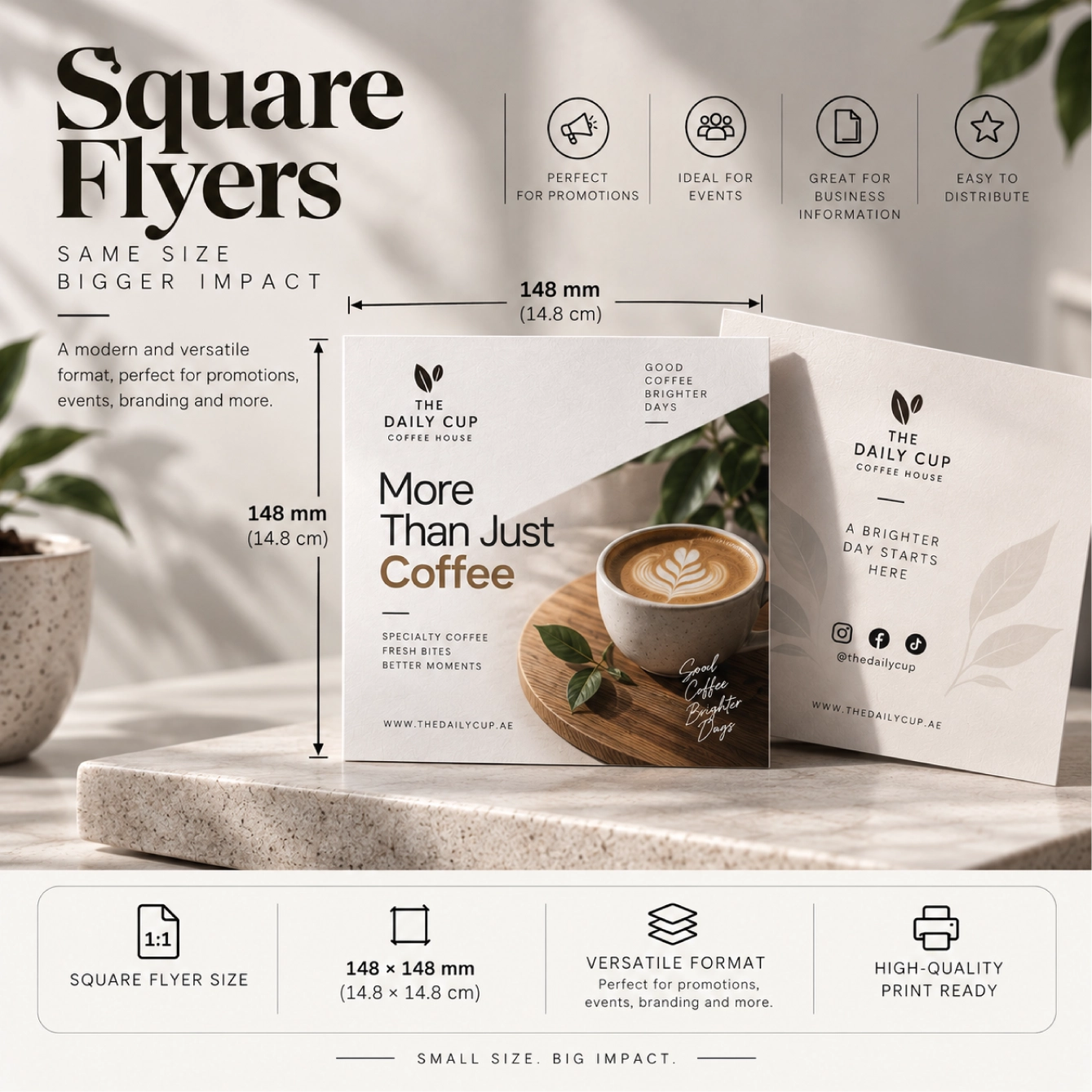
Square Flyers
Square flyers do not have one universal size. They can be produced in different square dimensions depending on the project.
A square format can be useful when visual branding and differentiation are important.
It can work well for:
- Creative campaigns
- Brand promotions
- Product launches
- Social-media-inspired print campaigns
The practical side should still be considered before choosing a square format, especially when the flyer will be distributed manually.
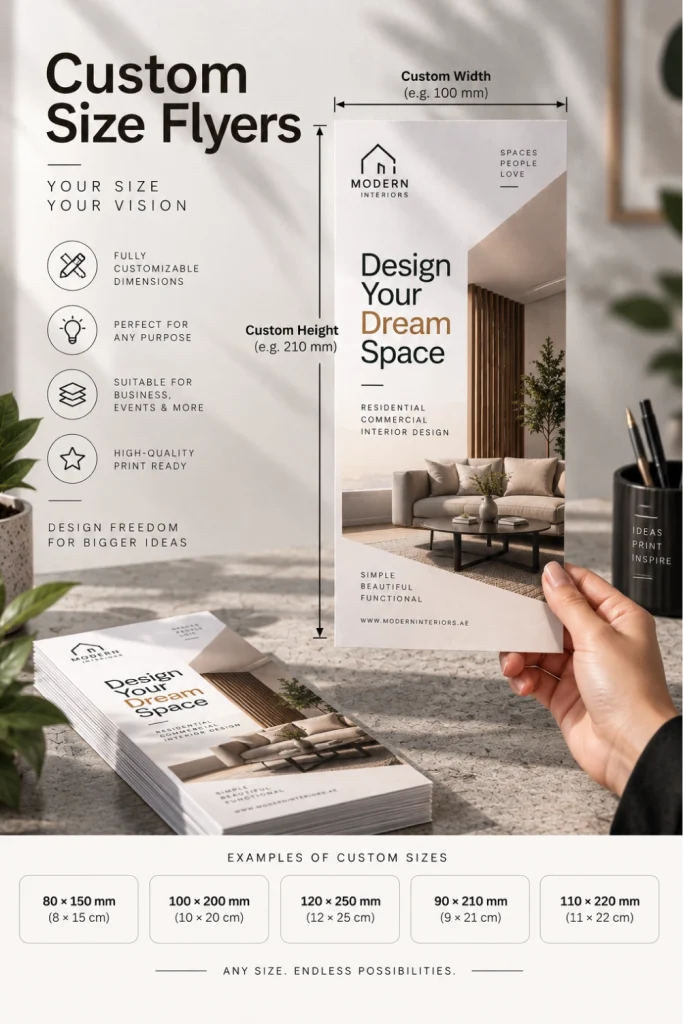
Custom Size Flyers
Custom-size flyers allow businesses to move beyond standard formats.
They can be useful when:
- The brand has a unique visual identity
- The campaign requires a special proportion
- A specific layout needs additional width or height
- The flyer is designed around a particular concept
Custom sizes require more planning because the final format can affect paper usage, trimming, production setup, and finishing.
Flyer Size Comparison
| Flyer Size | Dimensions | Best For | Common Uses |
|---|---|---|---|
| A6 | 105 × 148 mm | Short messages | Coupons, offers, promotions |
| A5 | 148 × 210 mm | General marketing | Business and promotional flyers |
| A4 | 210 × 297 mm | More detailed content | Services, offers, product information |
| A3 | 297 × 420 mm | Larger visual communication | Promotions and display |
| DL | 99 × 210 mm | Narrow, concise layouts | Menus, inserts, coupons |
| Square | Varies | Creative branding | Promotions and campaigns |
| Custom | Project-specific | Special requirements | Custom marketing campaigns |
A5 Flyers vs A4 Flyers
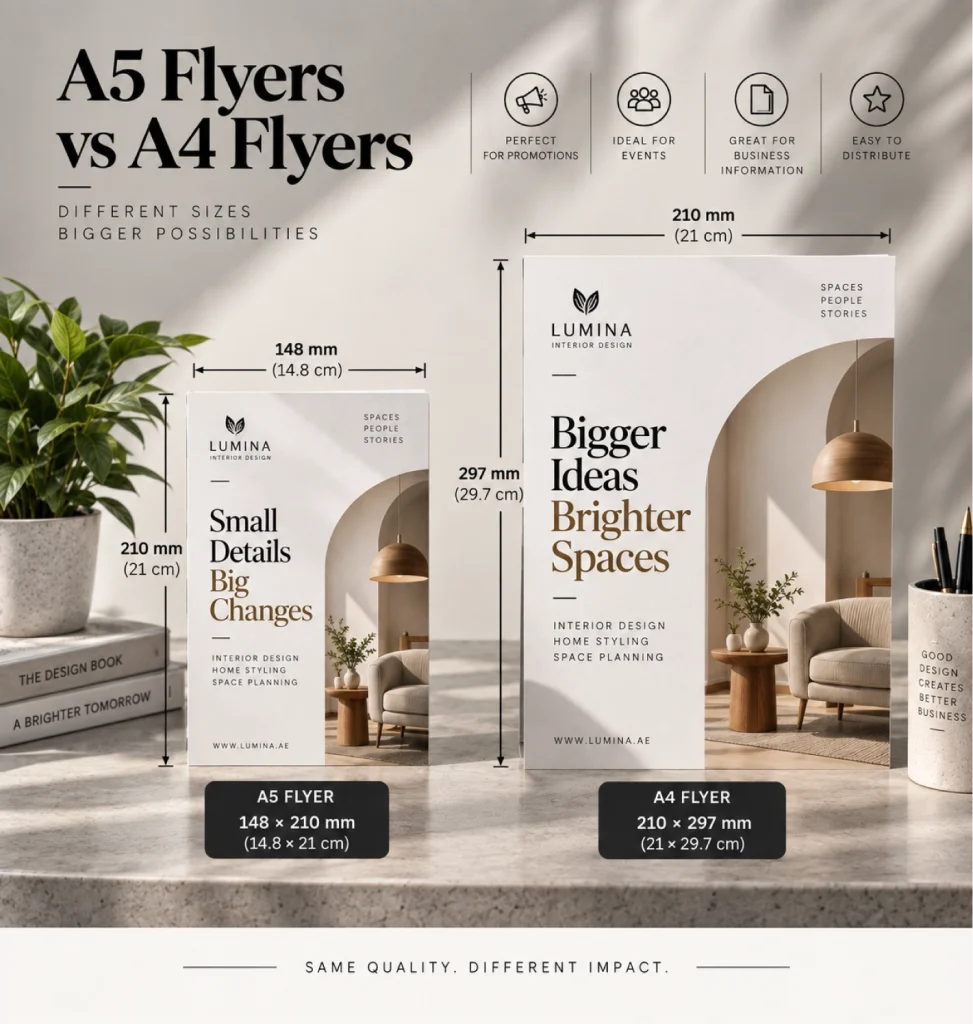
The right choice between A5 and A4 depends mainly on the amount of information and the distribution method.
A5 Flyers
A5 is easier to handle and distribute while still providing enough space for most promotional messages.
A4 Flyers
A4 provides more room for images, multiple services, product details, and supporting information.
| Factor | A5 | A4 |
|---|---|---|
| Size | Smaller | Larger |
| Portability | High | Lower |
| Content Area | Moderate | Large |
| Distribution | Very practical | Depends on campaign |
| Best For | Promotions | More detailed communication |
The key question is not which size is “better,” but which size supports the marketing objective more effectively.
Different Flyer Shapes
Flyers can use more than the traditional rectangle. The shape itself can contribute to the visual identity of a campaign.
Standard Rectangle Flyers
The standard rectangular flyer remains one of the most practical options.
It is easy to:
- Design
- Stack
- Store
- Distribute
It is suitable for businesses looking for a reliable and versatile format.
Square Flyers
Square flyers can create a more contemporary visual appearance and help differentiate a campaign from conventional rectangular materials.
They can be especially useful when the design is strongly image-led.
Long / DL Flyers
Long formats are suitable for vertically structured information and compact promotional messages.
They are especially useful when the content benefits from a strong top-to-bottom reading flow.
Die-Cut Flyers
Die-cut flyers are cut into custom shapes rather than standard rectangles.
The shape can be inspired by:
- A product
- A logo
- A brand element
- A visual concept
- A campaign theme
Die-cut flyers can create stronger visual differentiation, but they require careful planning around cutting lines, bleed, and artwork preparation.
Unique Custom Shapes
Unusual shapes can help attract attention, but the shape should serve a purpose.
A creative shape that is difficult to distribute, store, or read may create more problems than benefits.
Single-Sided vs Double-Sided Flyers
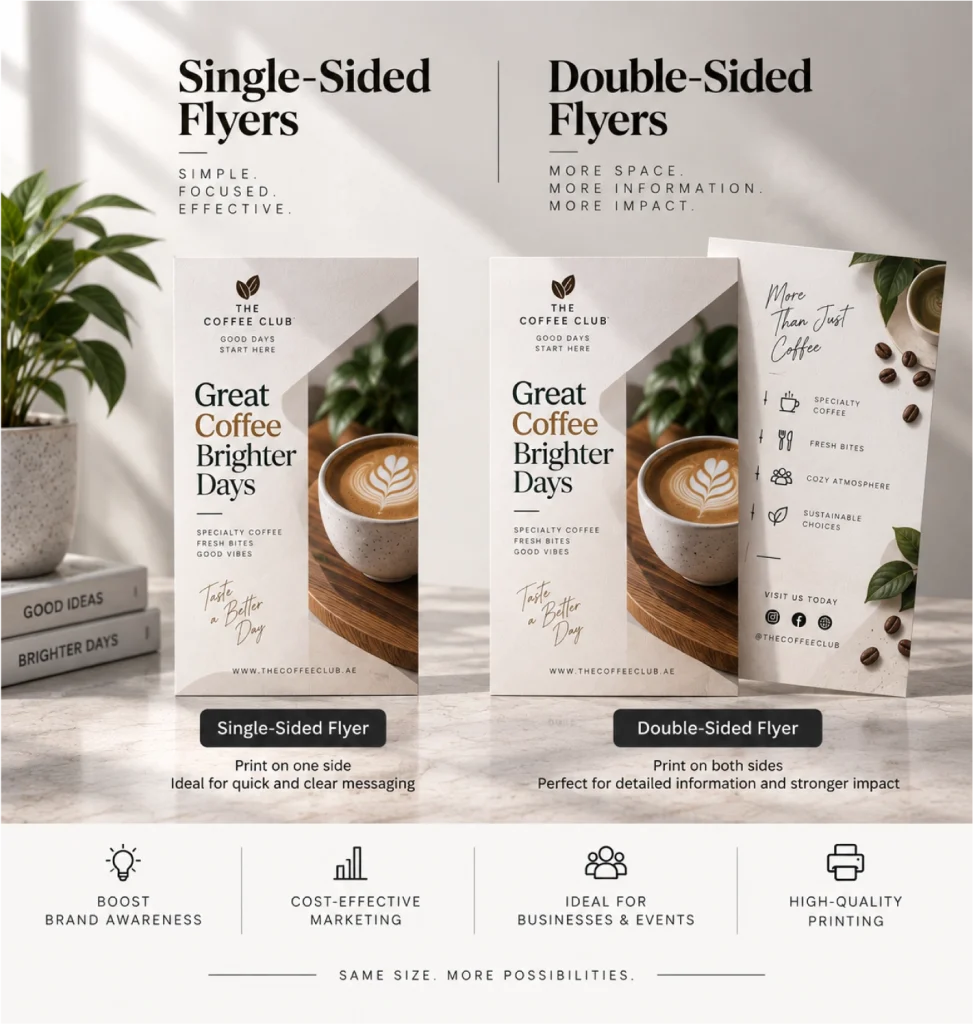
A flyer can be printed on one side or both sides.
Single-Sided Flyers
Single-sided printing is useful when the message is short and needs to be delivered immediately.
It works particularly well when:
- The campaign has one key message
- The design is highly visual
- There is limited supporting information
Double-Sided Flyers
Double-sided printing provides additional space and allows information to be divided logically.
For example:
Front:
Headline + Main Visual + Offer + CTA
Back:
Details + Services + Contact Information + QR Code
| Feature | Single-Sided | Double-Sided |
|---|---|---|
| Content Space | Limited | Larger |
| Layout | Simple | More flexible |
| Information | Short | More detailed |
| Best Use | Direct messaging | Detailed campaigns |
Flyer Paper Types and GSM
The choice of paper can affect how a flyer looks, feels, and performs.
Coated Paper
Coated paper provides a smoother surface that is often suitable for colorful promotional designs and image-heavy layouts.
Uncoated Paper
Uncoated paper provides a more natural paper feel and may be suitable for designs where a less glossy appearance is preferred.
Matte Paper
Matte surfaces reduce visible reflections and can create a cleaner, more understated visual appearance.
Glossy Paper
Glossy surfaces provide a shiny finish and can make colors and photography appear more vibrant.
Cardstock
Cardstock is appropriate when greater rigidity and a more substantial feel are desired.
What Does GSM Mean?
GSM stands for grams per square meter and is commonly used to describe the weight of paper.
A higher GSM generally indicates a heavier paper, but GSM alone does not determine which paper is best.
The appropriate paper depends on:
- Intended use
- Design
- Printing method
- Finishing
- Desired feel
- Budget
There is no single GSM that is automatically ideal for every flyer project.
Flyer Printing Finishes
Finishing can enhance appearance, texture, or durability depending on the specification.
Matte Finish
Matte provides a non-glossy appearance and can create a clean and professional visual style.
Gloss Finish
Gloss creates a reflective surface and can work well for photography and visually strong promotional graphics.
Lamination
Lamination adds a protective layer and can change the overall feel and durability of the printed piece.
Spot UV
Spot UV applies a localized glossy effect to selected areas such as:
- Logos
- Headlines
- Graphic details
- Brand elements
Premium finishing should be selected strategically rather than added simply because it is available
Digital vs Offset Flyer Printing
Both digital and offset printing have advantages depending on the project.
| Factor | Digital Printing | Offset Printing |
|---|---|---|
| Short Runs | Often practical | May require more setup |
| Large Quantities | Depends on project | Often suitable |
| Personalization | Highly flexible | More limited |
| Setup | Generally faster | More preparation |
| Turnaround | Often suitable for quick jobs | Depends on setup and quantity |
| Cost | Depends on quantity/specification | Can become efficient at suitable volumes |
The best method depends on:
- Quantity
- Artwork requirements
- Paper
- Color requirements
- Finishing
- Personalization
- Production schedule
It is therefore inaccurate to say that one method is always better or cheaper.
Choosing the Right Flyer Size for Your Business
Restaurants
A5 and DL can be practical for promotional offers, special menus, seasonal campaigns, and discounts.
Cafes
A6, A5, or DL can work well for beverage promotions, seasonal offers, and new product announcements.
Retail Stores
A5 or A4 can provide enough space for product images, prices, promotional messaging, and campaign details.
Real Estate
A4 can be useful when a flyer needs to include property photography, specifications, location information, and contact details.
DL may be more suitable when the information is intentionally compact.
Clinics
A5 or A4 can work depending on the amount of information being communicated.
The design should prioritize clarity, readability, and responsible presentation of information.
Beauty Salons
A6, A5, or DL formats can be effective for service promotions, packages, and seasonal offers.
Events
A5, DL, or custom sizes can be considered depending on the event identity and distribution strategy.
Corporate Businesses
A5 and A4 are commonly practical choices depending on the level of detail required.
Promotional Campaigns
The ideal flyer size depends on the campaign rather than a universal rule.
Consider:
Message + Audience + Distribution + Design + Budget
before selecting the format.
Common Flyer Design Mistakes to Avoid
Too Much Text
Flyers should communicate quickly. Long blocks of text can reduce readability and weaken the primary message.
Weak Visual Hierarchy
The headline, offer, supporting information, and CTA should have clear visual priorities.
Low-Resolution Images
Poor image quality can become especially noticeable in professional print production.
Poor Contrast
Text must remain clearly readable against its background.
No Clear Call to Action
A flyer should make the next step obvious.
Examples include:
Call Now
Visit Us
Scan the QR Code
Book Today
Learn More
Wrong Size
A poorly selected format can create unnecessary empty space or force important content into an overcrowded layout.
No Bleed
Backgrounds and images that extend to the edge of a trimmed flyer generally require bleed according to the printer’s specifications.
Ignoring Safe Area
Important text and logos should not sit too close to the trim area.
Incorrect Color Setup
Artwork should be prepared according to the printing process and the printer’s technical requirements.
How to Prepare a Flyer for Professional Printing
Before submitting artwork, review the following technical requirements.
CMYK
Confirm that your color setup is appropriate for the intended print workflow.
300 DPI / PPI
High-quality images should be prepared at an appropriate effective resolution for the final output size. A commonly used target for many print workflows is around 300 PPI, but the actual requirement depends on the project and printing process.
Bleed
Extend edge-to-edge artwork beyond the final trim area when required.
Trim
Clearly define the final finished dimensions.
Safe Area
Keep important text, logos, and design elements inside a safe distance from the trim.
Fonts
Make sure fonts are correctly handled according to the output workflow, whether through embedding or outlining where appropriate.
Vector Graphics
Use vector artwork for logos, icons, and scalable graphic elements whenever appropriate.
Print-Ready PDF
PDF is widely used in professional print workflows, but the exact export settings should follow the specifications of the print provider.
Image Resolution
Check the effective resolution of all placed images at their final size.
Color Management
Review color conversion and output settings before exporting the final print file.
The exact technical specifications may vary between printers, materials, presses, and finishing methods, so the printer’s artwork guidelines should always take priority.
How Much Does Flyer Printing Cost?
There is no universal price for flyer printing.
The final cost can be affected by:
- Quantity
- Flyer size
- Paper type
- GSM
- Single-sided or double-sided printing
- Finishing
- Custom shape
- Printing method
- Artwork requirements
- Production specifications
For this reason, comparing prices without comparing specifications can be misleading.
A meaningful quote should clearly define the quantity, size, paper, finishing, printing method, and artwork requirements.
How to Choose a Flyer Printing Service in Dubai
When selecting a printing provider, price should not be the only consideration.
Look at:
Print Quality
Review samples or previous work when possible.
Material Options
Check the available paper types, GSM options, and finishing choices.
Design Support
Consider whether professional design assistance is available if you do not already have print-ready artwork.
File Preparation
Make sure the provider clearly communicates requirements for bleed, color setup, dimensions, and PDF output.
Proofing
For important campaigns, proof approval can help identify problems before full production.
Turnaround
Confirm the actual production schedule rather than relying on generic claims such as “fast printing.”
Flyers as Part of a Marketing Campaign
Flyers can become more effective when integrated into a broader marketing campaign.
For example, a printed flyer can include a QR Code that connects customers to:
- A landing page
- An online offer
- A booking page
- A social media account
- A digital menu
- A product page
Flyers can also work alongside:
- Social media campaigns
- Events
- Retail promotions
- Email marketing
- Landing pages
- Promotional campaigns
This turns the flyer into a bridge between offline and digital marketing rather than treating the printed piece as an isolated asset.
Professional Flyer Printing Tips
Start with the final print size before creating the design.
Choose paper based on usage and appearance rather than GSM alone.
Keep the primary message immediately visible.
Use finishing options only when they support the visual identity or purpose.
Confirm technical specifications with the printer before finalizing artwork.
Review proofing carefully when color accuracy and fine details are important.
Keep the original editable design file separate from the final print-ready PDF.
Frequently Asked Questions About Flyer Printing
What is the best flyer size?
There is no single best flyer size for every campaign. A5 is a practical choice for many promotional applications, while A4 can be better when more information is required. DL can work well for compact vertical layouts.
Is A5 good for flyers?
Yes. A5 provides a useful balance between design space and portability, making it suitable for many promotional and business applications.
What is DL flyer size?
A common DL flyer size is 99 × 210 mm. It is a narrow vertical format commonly used for compact promotions, menus, inserts, and service information.
Should flyers be printed on both sides?
It depends on the amount of information. Single-sided printing works well for short messages, while double-sided printing provides additional space for details and supporting information.
What paper is best for flyers?
The best paper depends on the design, usage, finish, printing process, and budget. Matte, glossy, coated, uncoated, and cardstock can all be suitable in different situations.
Are glossy or matte flyers better?
Neither option is always better. Glossy can emphasize photography and vibrant visuals, while matte provides a less reflective and more understated appearance.
What GSM is suitable for flyers?
The right GSM depends on the intended application, paper type, printing process, finishing, and budget. There is no universal GSM that works for every flyer.
Can flyers be printed in custom shapes?
Yes. Die-cutting can be used to create custom flyer shapes, but the artwork must be prepared carefully around the cutting path and bleed requirements.
What file format is best for flyer printing?
A properly prepared PDF is commonly used in professional print workflows. The final export settings should follow the print provider’s specifications.
How should I prepare a flyer before printing?
Confirm the final dimensions, color setup, bleed, safe area, image resolution, fonts, vector elements, and PDF export settings before submitting the artwork.
Looking for Flyer Printing in Dubai in a standard size or custom shape?
The right choice depends on your business, campaign objective, content, distribution method, paper preference, and budget.
Request a quote or discuss your required flyer size, paper type, finishing, custom shape, and printing method before production to ensure the final printed piece matches your marketing goal.