
types of business cards
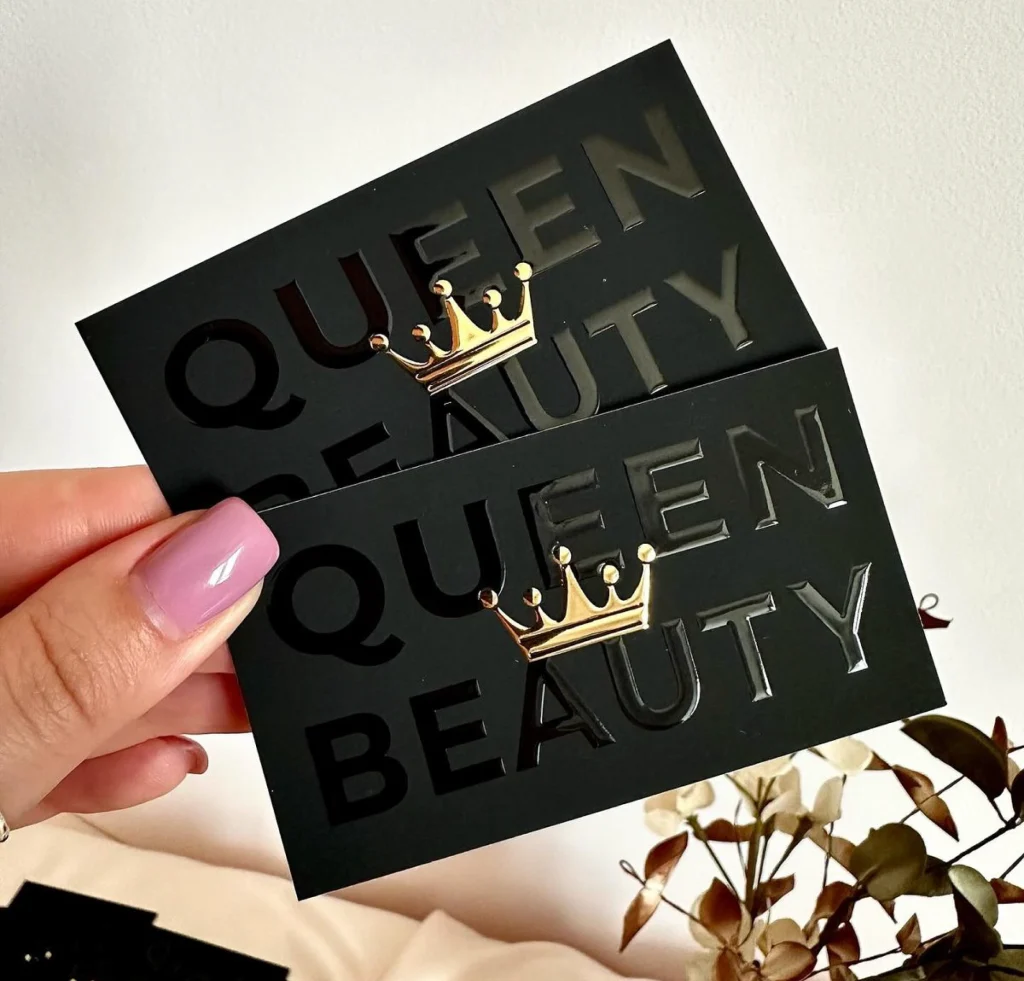
Types of Business Cards and Their Uses:
How to Choose the Best Business Card for Your Business
A Business Card is more than just a piece of paper containing a phone number and a company name. It is a small but important part of your visual identity and the first impression customers have of your brand. That is why types of business cards vary in terms of material, thickness, printing method, finish, shape, and purpose.
Choosing the right business card depends on your type of business, target audience, budget, and the image you want your brand to communicate.
A business card can be simple and practical for companies that need to distribute large quantities, or premium and luxurious with techniques such as Foil, Spot UV, and Embossing for brands that want to emphasize quality, luxury, and attention to detail.
There is no single business card that is the best choice for everyone. The right option is the one that supports your brand identity and the purpose of the card.
What Is a Business Card?
A business card is a printed communication tool used to share essential contact and professional information about an individual or company.
It commonly includes:
- Brand logo
- Company name
- Employee name
- Job title
- Phone number
- Email address
- Website
- Social media accounts
Business Cards play an important role in professional meetings, networking events, exhibitions, sales activities, and direct communication with customers and business partners.
However, their purpose goes beyond simply providing contact information. A well-designed business card becomes part of the overall brand experience, especially when the colors, typography, logo, material, and finishing techniques are consistent with the brand identity.
Business Card vs Personal Card vs Corporate Card
Business Card: Usually used to introduce a person representing a business or company.
Personal Card: Often used by freelancers, independent professionals, or individuals who want to present their professional and personal information in a more flexible format.
Corporate Card: Designed around a company’s corporate identity and commonly used by businesses and employees while maintaining consistency in branding, colors, logos, and information.
Main Types of Business Cards
1. Traditional Paper Business Cards
Traditional paper business cards are a practical choice for a wide range of companies and businesses. They are usually designed with a clear layout that focuses on essential information and visual identity.
One of their main advantages is that they work well for everyday use and can be produced with different finishes depending on the available budget.
They are particularly suitable for:
- Companies and organizations
- Sales and customer service teams
- Small businesses
- Employees
- Exhibitions and events
- Businesses that need to distribute large quantities of cards
The main disadvantage appears when a basic material and finish are combined with a generic design that does not distinguish the brand. In such cases, the card may look similar to many other business cards.
2. Premium Business Cards
Premium Business Cards are designed for brands that want their cards to be part of a more luxurious brand experience.
They can use high-quality materials combined with special finishes such as:
- Gold Foil
- Silver Foil
- Spot UV
- Embossing
- Soft Touch
These cards are especially useful when first impressions and perceived quality are an important part of the sales process.
They are suitable for businesses such as:
- Luxury real estate companies
- Law and consulting firms
- Investment companies
- Premium brands
- Jewelry businesses
- Luxury salons and beauty centers
- Premium automotive services
However, one important point should be considered: using more finishing techniques does not automatically make a business card better. Every finish should support the design and brand identity rather than being added purely for decoration.
3. Matte Business Cards
Matte Business Cards provide a calm and elegant appearance compared with glossy surfaces. They are commonly used in designs that focus on simplicity and corporate branding.
They can be a strong choice for companies that want a professional appearance without excessive visual effects.
Key advantages include:
- Elegant and subtle appearance
- Suitable for minimalist designs
- Compatible with corporate identities
- Helps maintain a refined look without strong glare
Matte Business Cards can be suitable for companies, consultants, designers, lawyers, professional offices, and other businesses that rely on a clear and professional image.
4. Glossy Business Cards
Glossy Business Cards feature a shiny surface that can make colors and images appear more vivid in certain applications.
They can be suitable for businesses that use strong colors or photography, although they are not necessarily the right option for every brand.
Advantages include:
- Shiny appearance
- Strong visual impact
- Suitable for creative designs and photography
One consideration is that strong reflections may affect the readability of certain information under direct lighting. The finish should therefore be selected according to the design and intended use.
5. Rounded Corner Business Cards
Rounded corners create a different visual character compared with traditional business cards with sharp corners.
They can be useful for modern brands or businesses that want their cards to have a more distinctive appearance.
They are particularly suitable for:
- Modern brands
- Startups
- Designers
- Technology services
- Creative businesses
The real advantage is not the rounded corner itself, but how well it fits the overall visual language and brand identity.
Special Business Card Finishes
The right finishing technique can transform a standard printed business card into a piece that reflects the quality and personality of a brand.
Spot UV
Spot UV is a glossy finish applied only to selected areas of the design instead of the entire card.
It can be used to highlight:
- Logo
- Company name
- Specific design elements
- Patterns and visual details
Its main visual characteristic is the contrast between matte and glossy areas.
Gold Foil
Gold Foil adds a metallic gold effect to selected elements of the design.
It is particularly suitable for luxury-focused brands such as:
- Jewelry companies
- Luxury real estate
- Premium products
Silver Foil
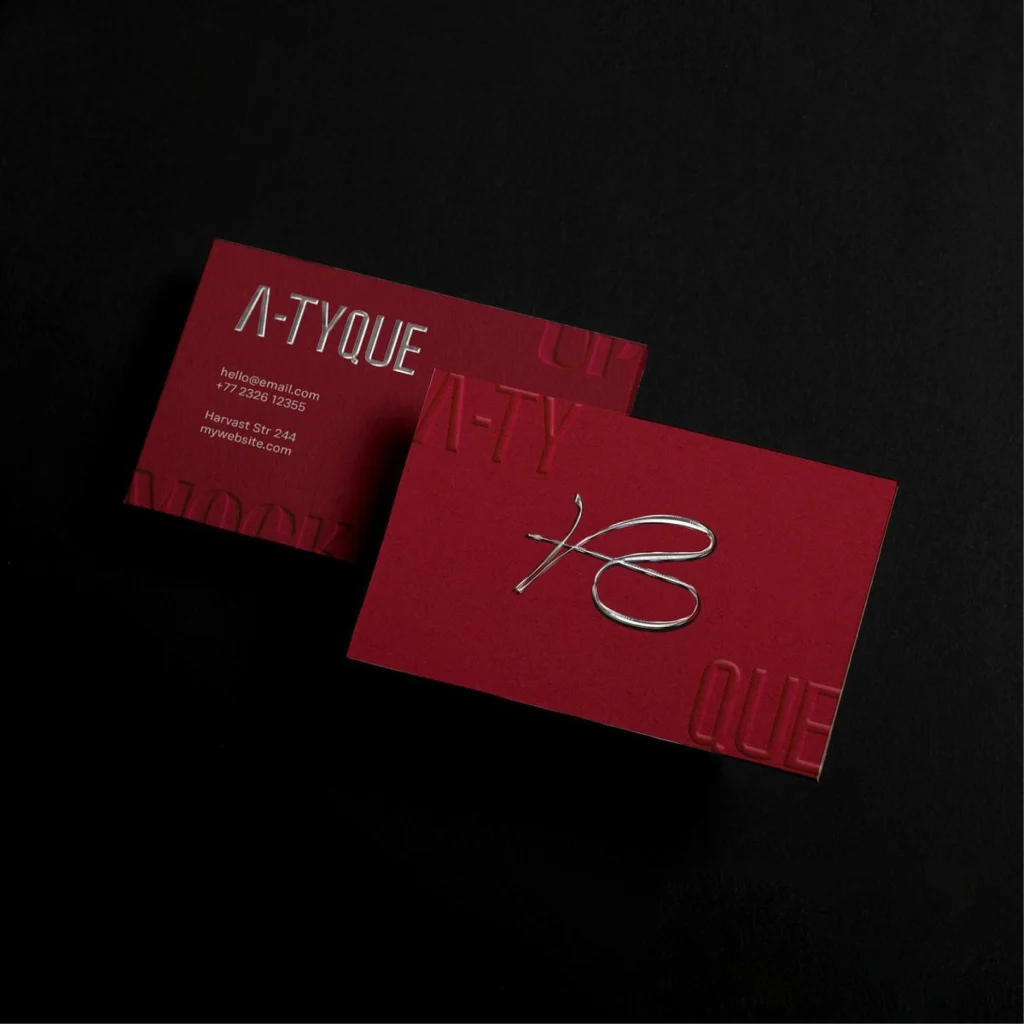
Silver Foil follows a similar concept but uses a metallic silver effect. It can work particularly well with modern, corporate, and technology-focused brands.
Embossing
Embossing creates a raised area on the surface of the card, adding a tactile and visual dimension.
It can be used to emphasize a logo, name, or important design element.
Debossing
Debossing is essentially the opposite of embossing. Instead of raising an element, it creates an indented effect within the material.
It is often used in elegant and minimalist designs that rely on subtle details.
Letterpress
Letterpress uses pressure to create a distinctive printed impression in the material. It is often selected for projects that want a handcrafted, premium, or traditional feel.
Soft Touch
Soft Touch finishing creates a smooth and distinctive feel when the card is handled. It can add a more luxurious tactile experience to the final product.
Laminated Finish
Lamination adds a protective layer and changes the overall appearance and feel of the card. Depending on the product and available specifications, it can be combined with matte or glossy finishes.
Types of Business Cards by Industry
Choosing the best Business Card should start with the business itself rather than the finishing technique alone.
| Business Type | Recommended Style | Suggested Finishes |
|---|---|---|
| Companies & Corporations | Simple and corporate | Matte / Lamination |
| Real Estate | Professional or luxurious | Matte / Spot UV / Foil |
| Law Firms | Formal and elegant | Matte / Embossing |
| Doctors & Clinics | Clean and clear | Matte |
| Restaurants & Cafés | Creative and visual | Glossy / Rounded Corners |
| Salons | Elegant and luxurious | Soft Touch / Foil |
| Construction Companies | Practical and corporate | Matte / Laminated |
| Automotive Businesses | Strong and modern | Matte / Spot UV |
| Photographers | Visual and creative | Glossy / Specialty Materials |
| Designers | Creative and distinctive | Special Finish |
| Marketers | Modern and clear | Matte / Rounded |
| Retail Stores | Simple and memorable | Matte / Glossy |
| Luxury Brands | Premium | Foil / Embossing / Soft Touch |
| Entrepreneurs | Practical and personality-driven | Matte / Rounded |
These are general recommendations rather than fixed rules. Visual identity, target audience, and practical use can all influence the final decision.
How to Choose the Best Business Card
Before starting the design, consider these 11 key factors:
1. Type of Business
Is your business formal, luxury-focused, youthful, technical, or creative?
Each answer may lead to a different visual direction.
2. Target Audience
A business card for a lawyer should not be designed in the same way as a card for a restaurant or graphic designer.
3. Visual Identity
The business card should be an extension of the company logo, colors, and typography rather than a completely separate design.
4. Budget
Start with the objective and then select the material and finish that fit the available budget instead of automatically adding every available technique.
5. Intended Use
Will the card be used for formal meetings, large-scale distribution, exhibitions, or high-value clients?
6. Paper or Material
The chosen material affects the appearance, tactile experience, and finishing possibilities.
7. Thickness
Thickness contributes to the perceived quality of the card, but it should be selected together with the material and printing method.
8. Finish
Choose the finishing technique according to what you want to emphasize in the design.
9. Card Size
The size should be compatible with the design, branding, practical use, and storage.
10. Printing Method
Printing capabilities and production costs can vary depending on the printing method, finish, and order quantity.
11. Printing Quantity
A large-volume order may require a different production approach than a small batch created for limited or specialized use.
What Is the Best Material for Business Cards?
There is no single material that can be described as the best option for every business.
When comparing materials, consider:
Quality: How does the material look and feel?
Thickness: Does it provide the desired tactile experience?
Appearance: Matte, glossy, or specialty finish?
Cost: Does it fit the budget?
Durability: Will the card be handled frequently?
Purpose: Does it support the business type and the desired brand image?
The right choice comes from balancing these factors rather than simply selecting the most expensive option.
What Is the Difference Between Standard and Luxury Business Cards?
| Feature | Standard Business Card | Luxury Business Card |
|---|---|---|
| Material | Practical and suitable for everyday use | More distinctive material depending on the project |
| Appearance | Simple and clear | More detailed and premium |
| Finish | Basic | May include Foil, Spot UV, or Embossing |
| Impression | Practical and professional | Premium and memorable |
| Use | Everyday use and wider distribution | Important clients and luxury brands |
| Cost | Generally lower | Generally higher depending on material and finish |
The key point is that a luxury business card is not always the best choice. In some cases, a simple and well-designed matte card can be more powerful and professional than a card overloaded with special effects.
Common Business Card Design Mistakes to Avoid
Some of the most common mistakes include:
Too Much Information
Adding every possible piece of information can make the card difficult to read.
Small Text
Information that customers cannot read easily does not serve its purpose.
Unclear Typography
Typography is part of the brand identity, but it must remain practical and readable.
Poor Contrast
There should be sufficient visual contrast between the text and the background.
Poor Color Selection
Colors should support the brand identity rather than work against it.
Ignoring Brand Identity
The business card should not look completely different from the rest of the brand’s visual applications.
Using a Low-Quality Logo
The logo is a key element, so a suitable print-ready file should be used. A vector logo is preferred whenever available.
Adding Unnecessary Information
A business card is not a miniature website. Include only the information that matters most.
Choosing the Wrong Material
The material and finish should support the desired brand image.
Using Too Many Finishing Techniques
Foil, Spot UV, and Embossing cannot replace good design.
What Information Should Be Included on a Business Card?
A business card may include:
- Logo
- Company name
- Employee name
- Job title
- Phone number
- Email address
- Website
- Address
- QR Code
- Social media accounts
However, not every business card needs all of these elements.
The best approach is to prioritize information according to the customer’s needs. For example, if customers primarily communicate through WhatsApp, the phone number or WhatsApp contact should receive greater visual priority.
Should You Add a QR Code to Your Business Card?
A QR Code can be useful when it helps move the customer from a physical card to a digital action.
It can direct users to:
- Website
- Google Maps
- Social Media
- Digital Business Card
- A specific landing page or contact form
However, it should not be used simply as a decorative element.
Before printing, make sure the QR Code is clear, scannable, and connected to a working destination.
The best QR Code is one that leads to something genuinely useful rather than simply opening a generic homepage.
Business Card Design for Printing
A good design on screen does not automatically mean that the artwork is ready for printing.
When preparing a Business Card, pay attention to important production elements such as:
- Bleed: Extra design area extending beyond the trim line.
- Safe Area: A protected area that keeps important elements away from the cut line.
- CMYK: A commonly used color system for print production.
- Resolution: Appropriate image resolution for raster elements.
- Vector Logo: Helps maintain logo quality at different sizes.
- Fonts: Ensure fonts are properly handled according to the printer’s workflow.
- Print-ready PDF: A final file prepared according to the printer’s production requirements.
Do not assume a universal bleed or production specification without confirming it with the printing company, because requirements can vary depending on the production system, material, and cutting method.
How Much Do Business Cards Cost?
There is no single price for all Business Cards.
Printing costs can be affected by:
- Paper or material type
- Thickness
- Quantity
- One-sided or double-sided printing
- Finishing technique
- Foil
- Spot UV
- Embossing
- Cutting method
- Order volume
For this reason, an accurate quotation should be based on clear specifications rather than a general question such as, “How much do business cards cost?”
How to Get a Professional Business Card
The best approach is to treat the project as part of your brand identity rather than as a simple printing task.
Start with these steps:
1. Define the objective: Why do you need the card and who will use it?
2. Prepare the visual identity: Logo, colors, and typography.
3. Select the information: Keep only the essential details.
4. Choose the size: Based on the design and intended use.
5. Select the material: Based on the desired image and budget.
6. Choose the finish: According to the identity rather than decoration alone.
7. Develop the design: Based on clear priorities.
8. Review the print file: Check all text, information, dimensions, and production requirements.
9. Approve the proof: Review the final version before production.
10. Start production: Once all details have been approved.
How to Choose Between Matte, Glossy, and Premium Business Cards
The choice can be simplified:
If you want a calm and professional corporate look, Matte is often a strong option.
If your design relies on strong colors, images, and visual shine, Glossy may be more suitable.
If you want a more luxurious and distinctive feel, consider Premium Finishes such as Soft Touch, Foil, or Embossing.
However, for brands built around simplicity, a high-quality matte card with an excellent design can be more effective than a luxury card overloaded with effects.
Conclusion: What Is the Best Business Card for Your Business?
The best business card is the one that creates the right balance between design, branding, material, functionality, and budget.
The goal is not to make the card as expensive as possible. The goal is to make it appropriate for the brand and the target audience.
A corporate company may need a simple and professional business card, while a luxury brand may benefit from premium materials and specialized finishes. On the other hand, a restaurant or creative business may benefit from a bolder design, stronger colors, or distinctive shapes.
Before choosing a material or finish, ask the most important question:
What impression do you want your business card to leave on your customer?
Do You Need Professional Business Card Design and Printing?
Choosing the right Business Card Design starts with understanding your business identity and target audience, followed by selecting the materials, finishes, and specifications that support that identity.
A complete business card solution can take your project from the initial design stage to a final print-ready file, with material and finishing recommendations based on your business type and budget.
Frequently Asked Questions About Business Card Types
What Are the Different Types of Business Cards?
Common types of business cards include traditional paper business cards, Matte, Glossy, Rounded Corner Business Cards, and Premium Business Cards that can feature finishes such as Spot UV, Foil, Embossing, and Soft Touch.
What Is the Best Material for Business Cards?
There is no single material that is best for everyone. The right choice depends on your business type, budget, intended use, desired appearance, and finishing requirements.
What Is the Difference Between Matte and Glossy Business Cards?
Matte Business Cards offer a more subtle, elegant, and professional appearance, while Glossy Business Cards feature a shiny surface and can be a suitable choice for designs that rely on bold colors and images.
Are Luxury Business Cards Worth the Cost?
Luxury Business Cards can be a good choice for brands that want to communicate a premium image or create a stronger first impression. However, they are not necessary for every type of business.
Can I Add a QR Code to a Business Card?
Yes. A QR Code can be used to direct customers to WhatsApp, your website, Google Maps, a Digital Business Card, or another relevant online destination.
What Information Should Be Included on a Business Card?
Essential information typically includes the logo, company name, person’s name, job title, and contact details. Depending on the purpose of the card, you can also include a QR Code, website, or social media accounts.
What Is the Best Business Card for Companies?
Companies generally benefit from a clear and professional design that follows their corporate identity. Matte Business Cards or simple professional finishes are often suitable depending on the brand style and budget.
What Is the Best Business Card for Luxury Businesses?
Luxury businesses can consider premium materials and finishes such as Soft Touch, Foil, and Embossing, provided that they complement the brand’s visual identity.
Can Business Cards Be Printed With Special Finishes?
Yes. Business Cards can be produced with a variety of special finishes depending on the printer, material, and production method, including Spot UV, Foil, Embossing, Debossing, and other finishing options.